TSB — Business Banking App
Compliant, without the scroll
TSB’s Business Banking customers had no fixed-term savings product. With only an instant access account on offer, we were losing deposits to competitors with stronger product ranges. I led UX and product design for a new Fixed Rate Bond journey, the first of its kind in TSB’s business suite, and designed end-to-end for the mobile app.
MY ROLE
Lead UX / Product designer
Platform
iOS & Android (SSO)
duration
6 months
Team
Product, Engineering, Legal

Impact at a glance
My role
End-to-end ownership across discovery, design, and delivery
Research & strategy
Scoped the brief, led discovery research, and defined the design direction
Journey design
Owned the end-to-end UX across product selection, calculator, and application
Prototyping & testing
Built and iterated prototypes through multiple rounds of usability testing
Stakeholder management
Collaborated with legal, product, and engineering to resolve design constraints
Problem
Business customers needed confidence, not just a new product
The brief framed this as a build problem: design a journey for a new product. But discovery surfaced a more specific challenge. Business Banking customers, franchise owners and SME operators evaluate fixed-term savings very differently from retail customers. They’re committing operational cash for months or years, so their primary concern isn’t the interest rate alone. It’s confidence: can they trust this bank with funds they can’t touch?
“Business customers committing operational cash for months need more than clarity, they need confidence. The interface had to be reassuring at every step.”
Reframe
From “design a savings journey” → “earn trust from business customers committing locked funds”
Competitor audit
Competitor evidence shaped the product decisions
We audited three competitor fixed-rate bond journeys across mobile and desktop, focusing on the decisions most likely to affect conversion - how quickly a customer could understand what they were committing to, how regulatory requirements were handled, and how much friction stood between intent and application. The audit directly informed five design decisions in our own journey.
Strong
Mixed
Weak
criteria
Competitor A
Competitor B
Competitor C
Rate & term visibility
Clear at product selection
Visible but secondary
Buried in detail page
Mobile optimisation
Well optimised throughout
Strong on mobile
Desktop-first, breaks on mobile
Regulatory disclosure
Summary box always visible
Accordion — hidden by default
Summary box always visible
Interest calculator
Not present
Not present
Not present
Application friction
Pre-populated for existing customers
Partial pre-population
Full form, no pre-population
Design challenge
Design decisions that balanced compliance and usability
Problem
Legal vs usability
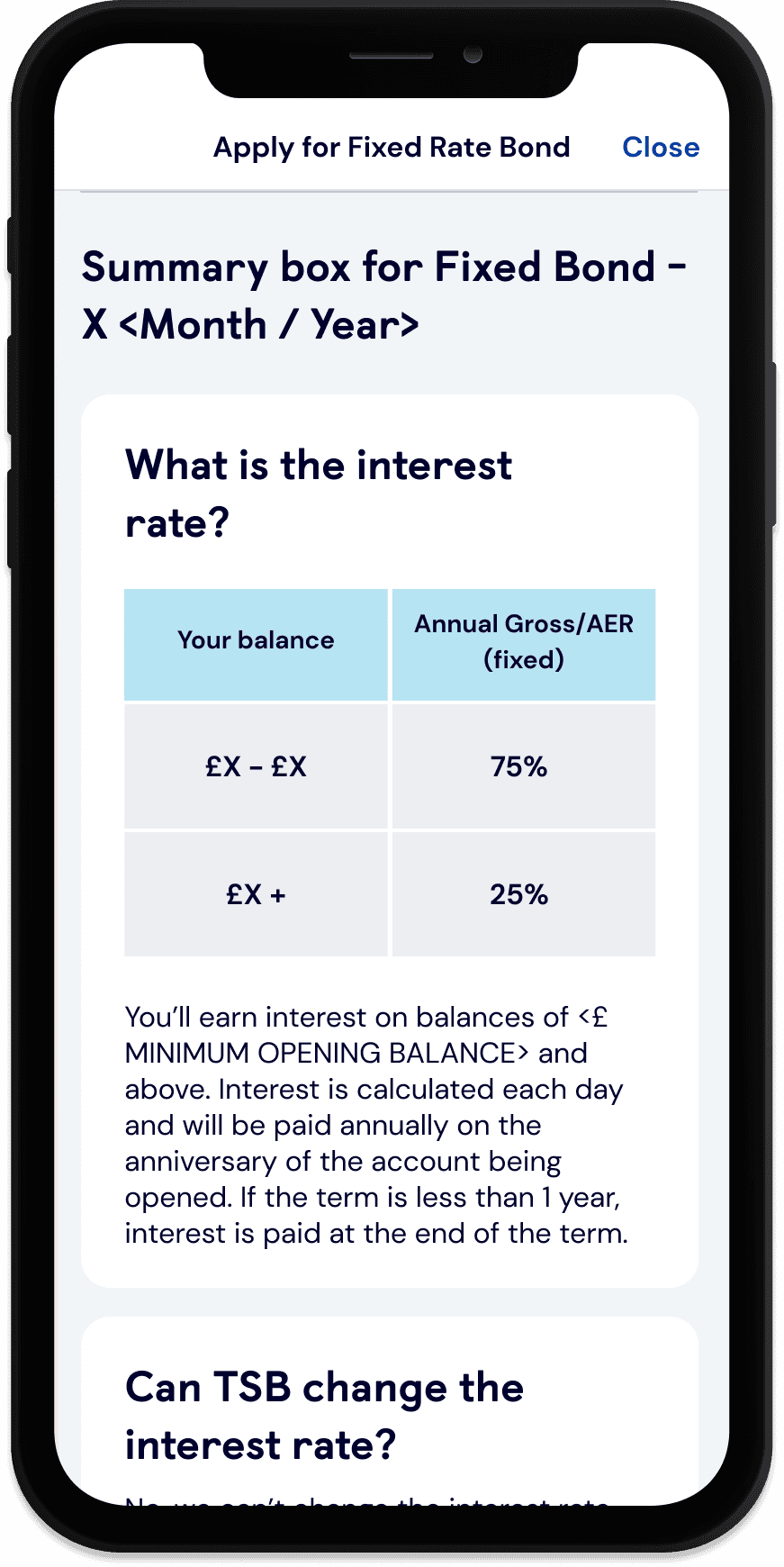
Legal required the summary box to remain visible at all times. This forced users to scroll excessively to reach the CTA, causing frustration and a significant number of users to hit close during testing.
Decision
Accordion pattern
We worked with legal to reframe the requirement. By presenting the summary box as an accordion, users could scan headings and expand only what they needed, satisfying legal compliance while removing the scrolling burden entirely.
Before

After
Outcome
A new savings product adopted in year one
In its first year, the Fixed Rate Bond generated 760 accounts and £73.6 million in deposits, establishing the first fixed-term savings product in TSB’s Business Banking suite and proving that business customers would engage with locked savings digitally when the journey gave them sufficient confidence to commit.
760
New accounts opened
£73.6m
Deposits in year one
What I’d do differently
Scope the interest calculator into MVP. Every competitor lacked it, it was a real opportunity to differentiate, and the data we gathered post-launch suggests it would have meaningfully increased conversion at the product selection stage.